
If your cat has ever walked over to the edge of a table, stared directly at you, and pushed your favorite object onto the floor, you're definitely not alone.
One minute your phone is sitting safely on the table. The next minute, your cat is casually watching it fall as if nothing happened. 😹
But why do cats knock things off tables? Are they being naughty, trying to get your attention, or simply having fun?
The truth is, cats knock things over for several reasons. Curiosity, play, boredom, hunting instincts, attention-seeking, and even hunger can all play a role.
In this guide, we'll explore why your cat knocks things off tables, whether they're doing it on purpose, and how you can reduce the behavior without making your cat stressed or scared.
Why Do Cats Knock Things Off Tables?
Cats don't usually knock things over simply to annoy their humans.
What looks like mischievous behavior can actually be a normal part of how cats explore their environment. They use their paws, eyes, nose, and other senses to investigate objects around them.
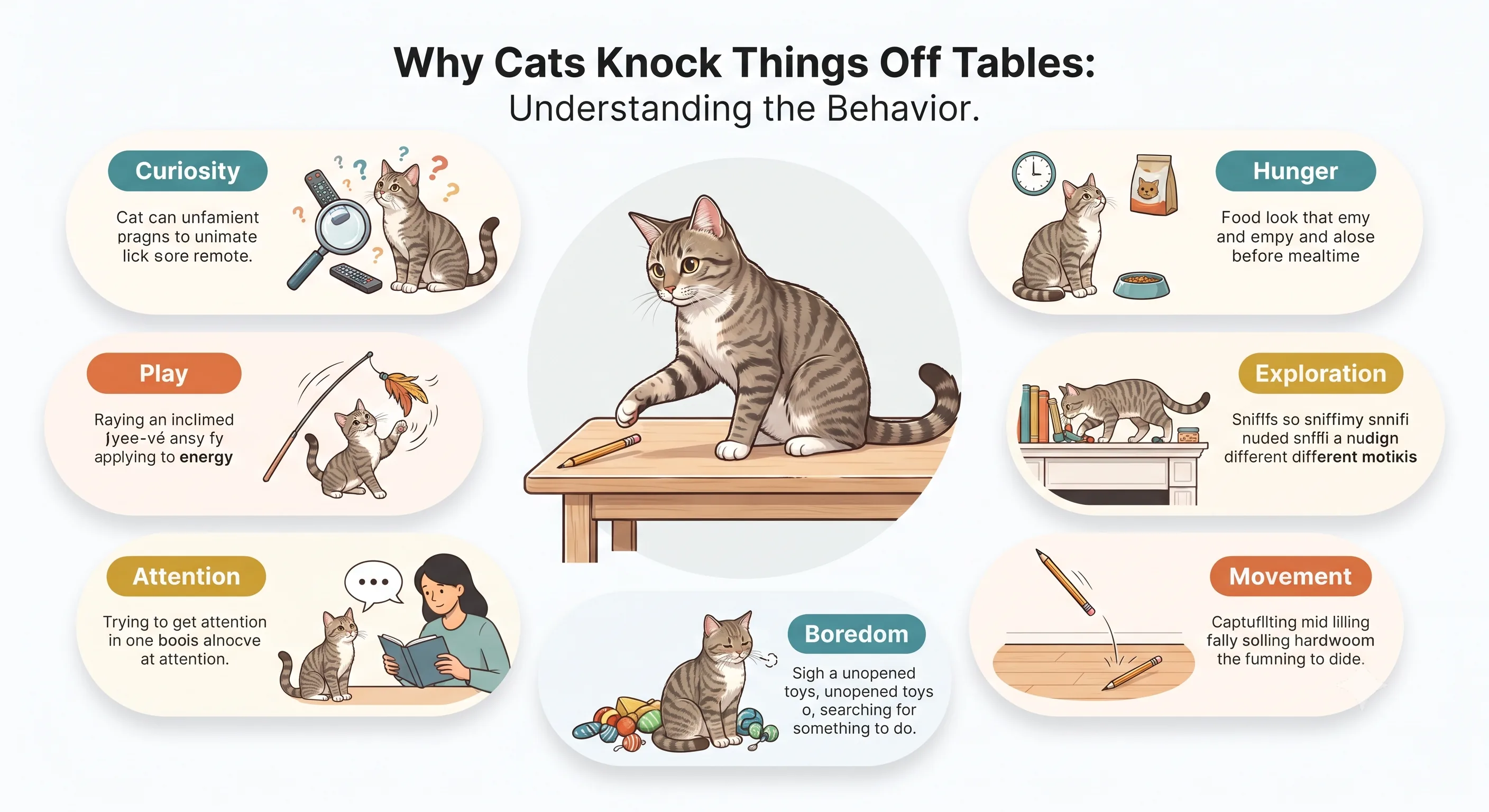
Here are some of the most common reasons your cat may be pushing things off the table.
1. Your Cat Is Curious
Cats are naturally curious animals.
If they see something unfamiliar sitting on a table, they may want to investigate it. A small object can be especially interesting if it moves, makes a sound, or has an unusual texture.
Your cat may first sniff the object, then touch it with a paw. If it moves, that makes the object even more interesting.
From your cat's point of view, pushing an object off the edge can be a tiny experiment:
What happens when I touch it? Does it move, fall, bounce, or make a sound?
Cats learn about their environment through this kind of hands-on exploration.
So when your cat pushes your pen onto the floor, they may not be trying to cause trouble. They may simply be investigating what happens when they interact with it.
2. They Want to Play
Sometimes, the object on your table simply looks like a toy.
A pen, bottle cap, piece of paper, hair tie, or even a pair of headphones can become an instant source of entertainment.
Cats are natural hunters, so they are attracted to things they can bat, chase, grab, and watch move.
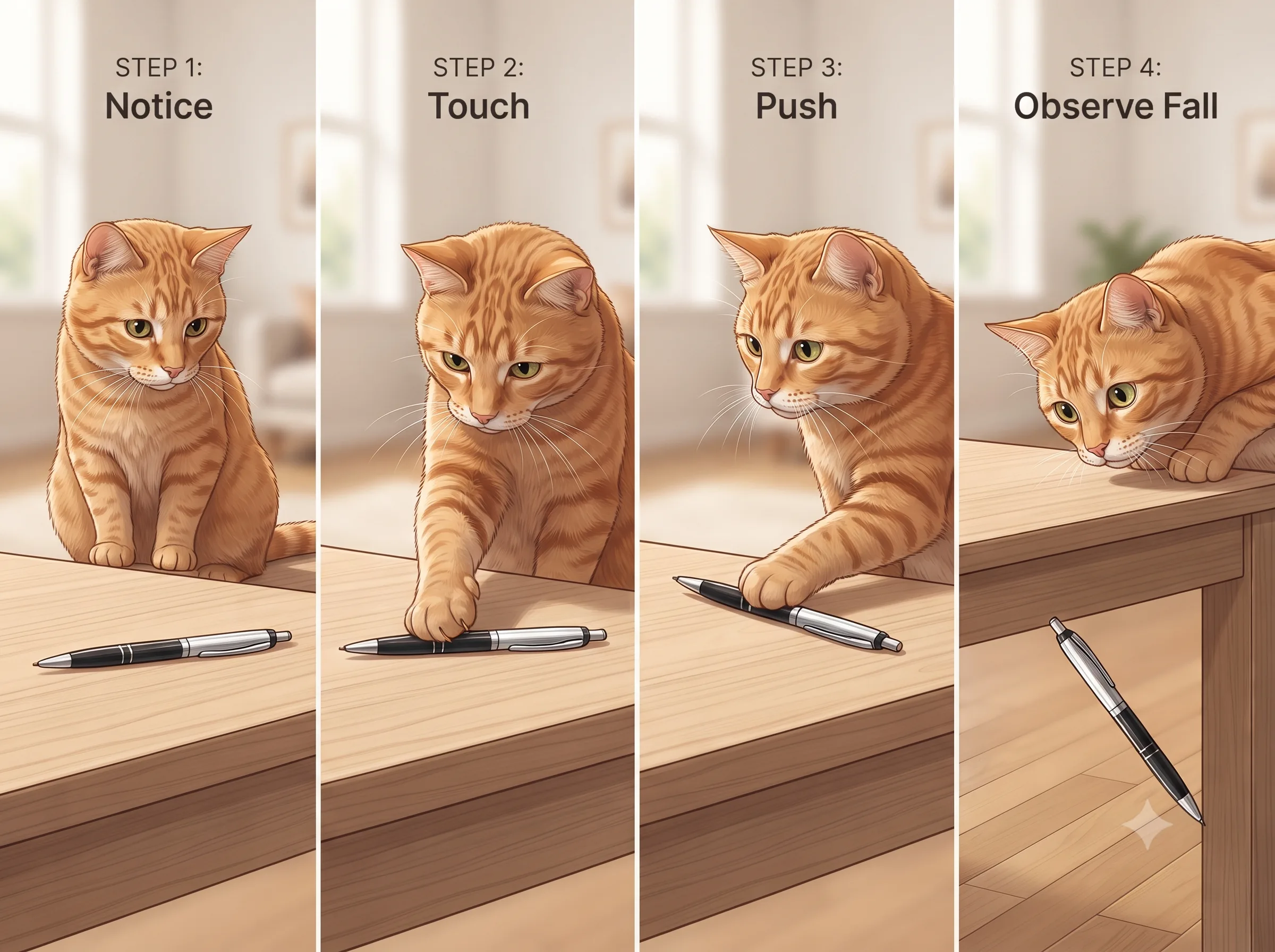
If the object falls to the floor and makes a noise, that's an added bonus.
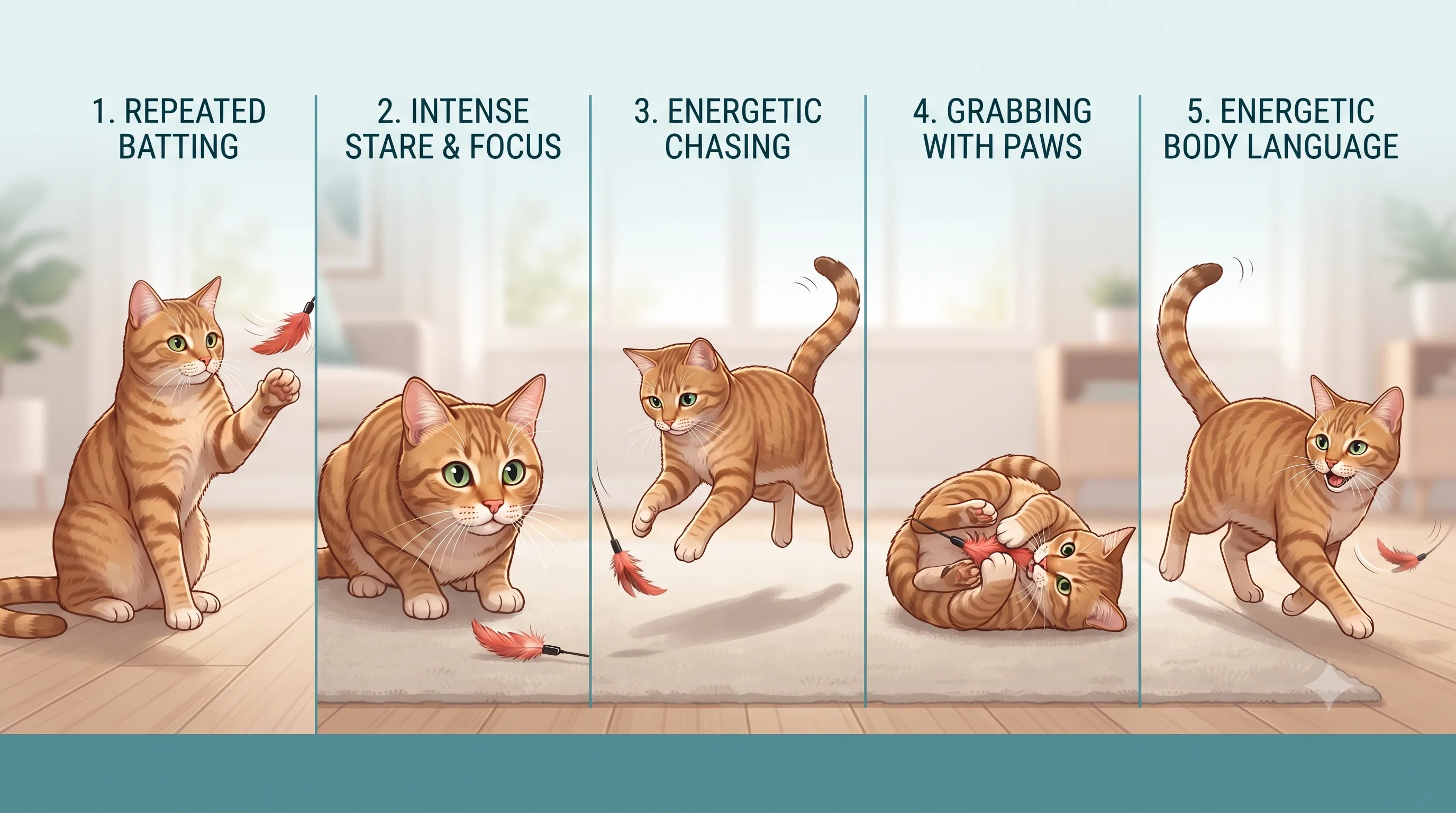
Signs Your Cat Is Playing
Your cat may be playing with an object if they:
- Bat it repeatedly with their paws
- Watch it closely before touching it
- Chase the object after it falls
- Try to grab or bite it
- Seem excited or energetic while doing it
If this sounds like your cat, they may simply need more appropriate opportunities to play.
Interactive toys can give them a safer outlet for the same chasing, batting, and pouncing behaviors.
3. Your Cat Wants Your Attention
For some cats, knocking things over becomes a surprisingly effective way to get their human's attention.
Imagine this:
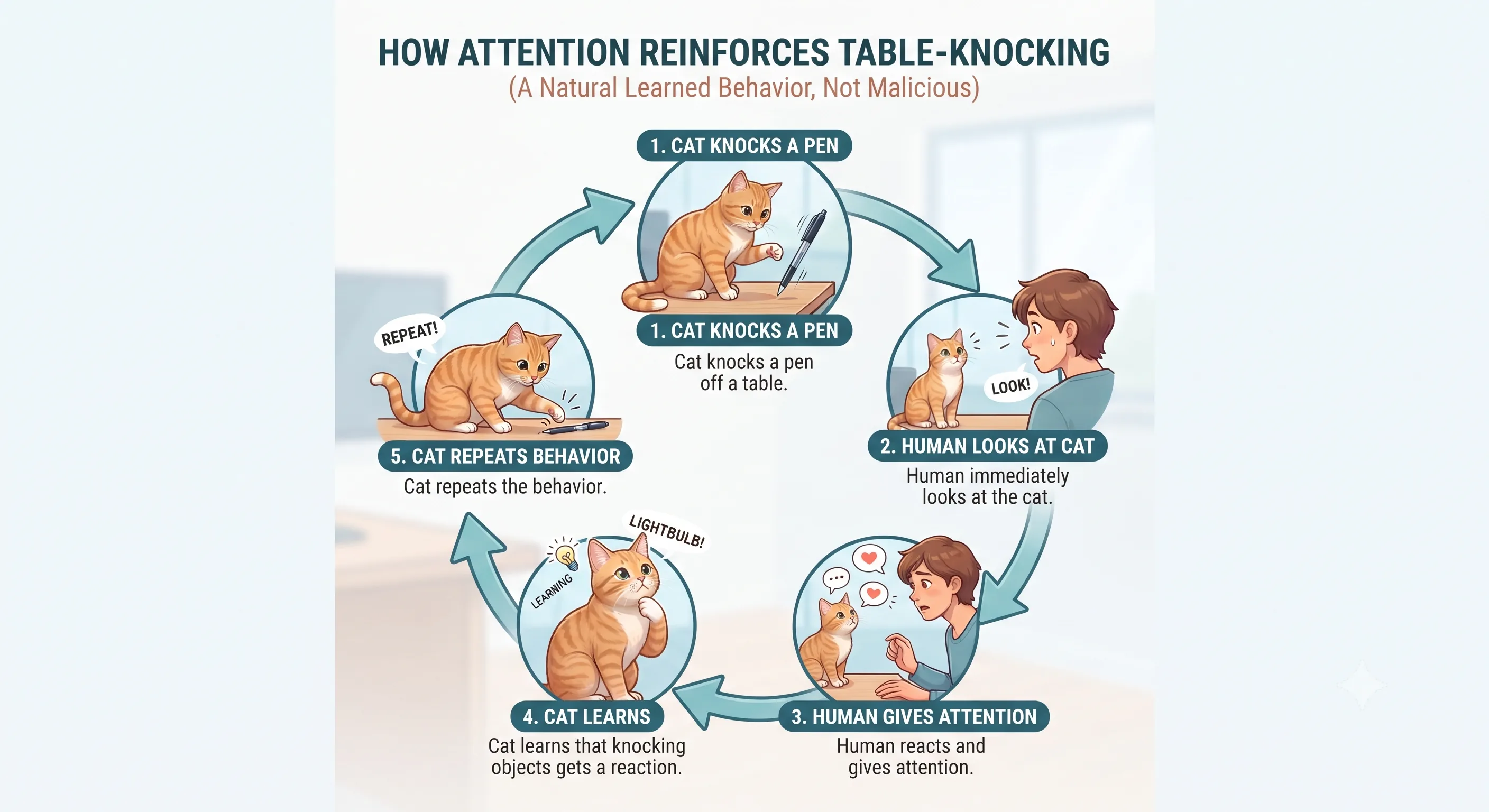
Your cat pushes a pen onto the floor.
You immediately look at them.
Maybe you say their name, get up, pick up the pen, and tell them to stop.
To your cat, that's attention.
Cats can learn patterns through repeated experiences. If knocking something over consistently causes you to react, your cat may learn that the behavior works.
The attention doesn't always have to be positive. Even saying "No!" or getting up to move the object is still interaction.
This can be especially common when your cat knocks things over while you're:
- Working at your desk
- Watching TV
- Using your phone
- Reading
- Talking to someone
- Ignoring them
Your cat may have discovered a very simple strategy:
Knock something over → human reacts → I get attention.
4. Your Cat Is Bored
A bored cat can become surprisingly creative.
If your cat spends most of the day indoors without enough opportunities to play, climb, scratch, explore, or solve simple problems, they may start creating their own entertainment.
And unfortunately, your table may become their personal playground.
Boredom may be more likely if your cat:
- Sleeps most of the day and becomes active at night
- Constantly looks for things to play with
- Gets into cupboards or drawers
- Scratches furniture frequently
- Demands attention repeatedly
- Knocks objects down when you're nearby
This is where cat enrichment can make a big difference.
Enrichment means giving your cat safe ways to stalk, chase, climb, scratch, explore, and solve simple problems.
A few interactive play sessions, puzzle feeders, climbing areas, scratching posts, and window perches can give your cat more appropriate things to do.
5. They Enjoy Watching Things Move and Fall
This one sounds funny, but it makes sense from a cat's perspective.
Cats are highly attentive to movement. Their hunting instincts are naturally triggered by things that move, bounce, roll, or suddenly change direction.
When your cat pushes an object, they can watch it move, fall, bounce, and sometimes roll across the floor.
That movement can be more interesting than the object itself.
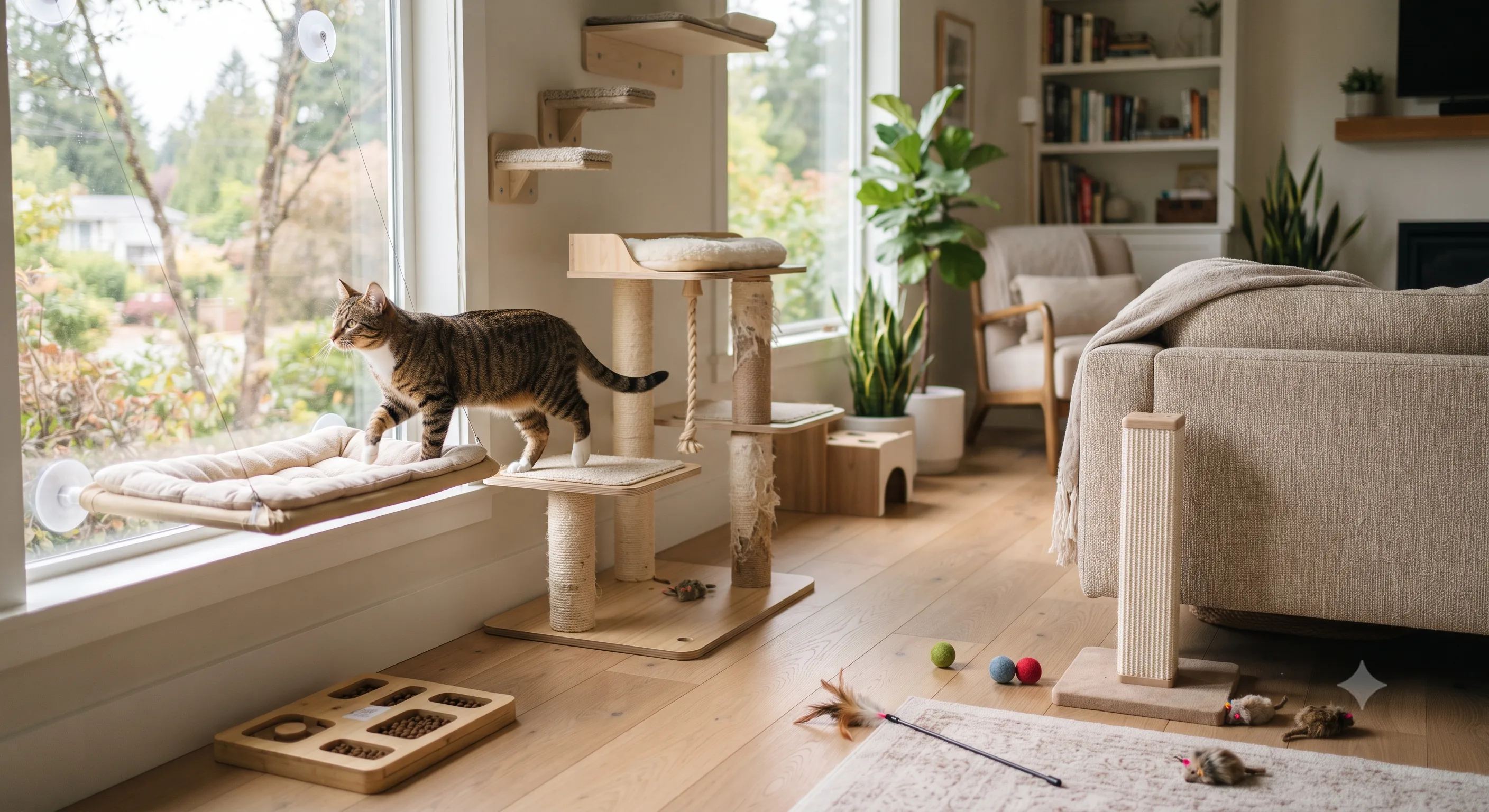
Your cat may not care about your pen or bottle cap at all. They may simply be fascinated by what happens after they push it.
This is one reason a cat may knock the same object off a table repeatedly.
6. They're Exploring Their Environment
Cats learn by interacting with the world around them.
A table can contain all kinds of interesting objects with different shapes, textures, weights, and sounds.
Your cat may discover that:
- A pen rolls
- A piece of paper slides
- A plastic bottle makes a noise
- A soft object barely moves
- A heavier object makes a different sound when it hits the floor
For your cat, this is immediate feedback.
Push the object.
It moves.
Push it harder.
It falls.
Try another object.
It makes a different sound.
This kind of interaction can help explain why cats sometimes repeat the same behavior over and over.
They're not necessarily trying to annoy you. They're exploring what different objects do when touched.
7. They May Be Hungry
Sometimes, knocking things over can be connected to your cat's daily routine.
If your cat starts knocking things over around the same time every day, especially before meals, they may have learned that certain behaviors get your attention.
Some cats become particularly persistent when they're hungry.
If the behavior consistently happens before breakfast or dinner, take a look at your cat's feeding routine and whether they are getting their meals consistently.
However, don't automatically give food every time your cat knocks something over.
Otherwise, they may learn that knocking things down is a great way to order room service. 😹
Instead, keep feeding times consistent and avoid turning table-knocking into a reward.
Is My Cat Knocking Things Off the Table on Purpose?
Sometimes, yes.
But "on purpose" doesn't necessarily mean your cat is being naughty.
Your cat may intentionally push an object because they have learned that it will move, make a sound, or get your attention.
That doesn't mean they're trying to frustrate you.
Cats don't think about behavior in exactly the same way humans do. They're usually responding to curiosity, instincts, learned associations, or immediate rewards.
So if your cat looks at you and pushes your favorite mug off the table, they may understand that their action produces a reaction.
But that doesn't mean they're sitting there thinking:
"I'm going to ruin my human's afternoon." 😹
Why Does My Cat Knock Things Over While Looking at Me?
This is the moment that makes many cat owners think:
"Oh, you KNOW what you're doing." 😹
If your cat looks directly at you before pushing something off the table, they may be checking your reaction.
They may already have learned that knocking things over gets your attention.
It can also be an invitation to interact, especially if your cat seems playful or energetic.
If your cat repeatedly does this while staring at you, try giving them a few minutes of interactive play instead of reacting dramatically to the object being knocked over.
A wand toy, small ball, or another appropriate toy can redirect that energy.
How to Stop Your Cat From Knocking Things Off the Table
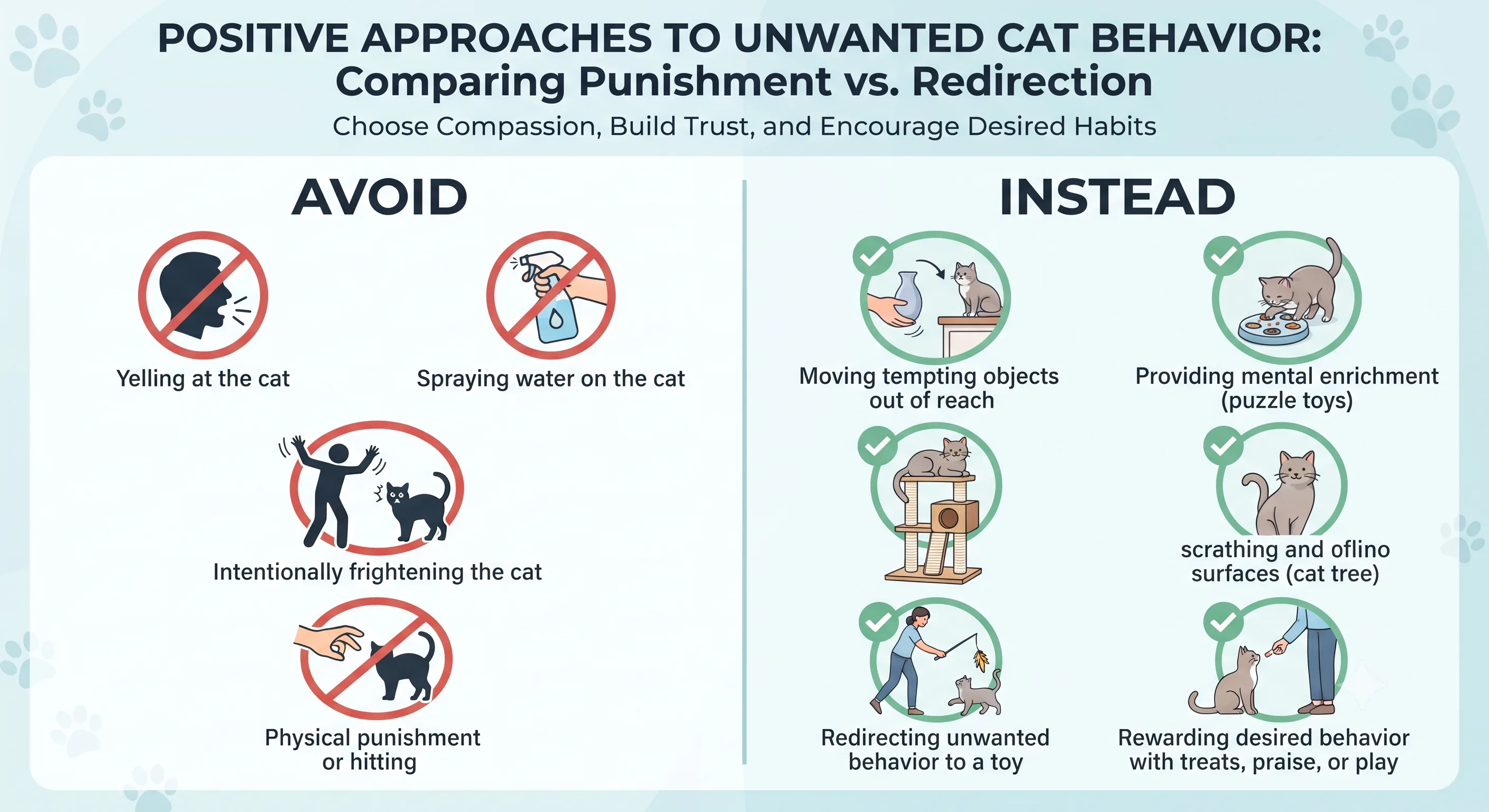
You don't need to punish your cat to reduce this behavior.
Instead, try to understand why your cat is doing it and make the alternative more interesting.
The goal isn't to eliminate your cat's natural curiosity. It's to give them safer and more appropriate ways to express it.
Identify the Reason First
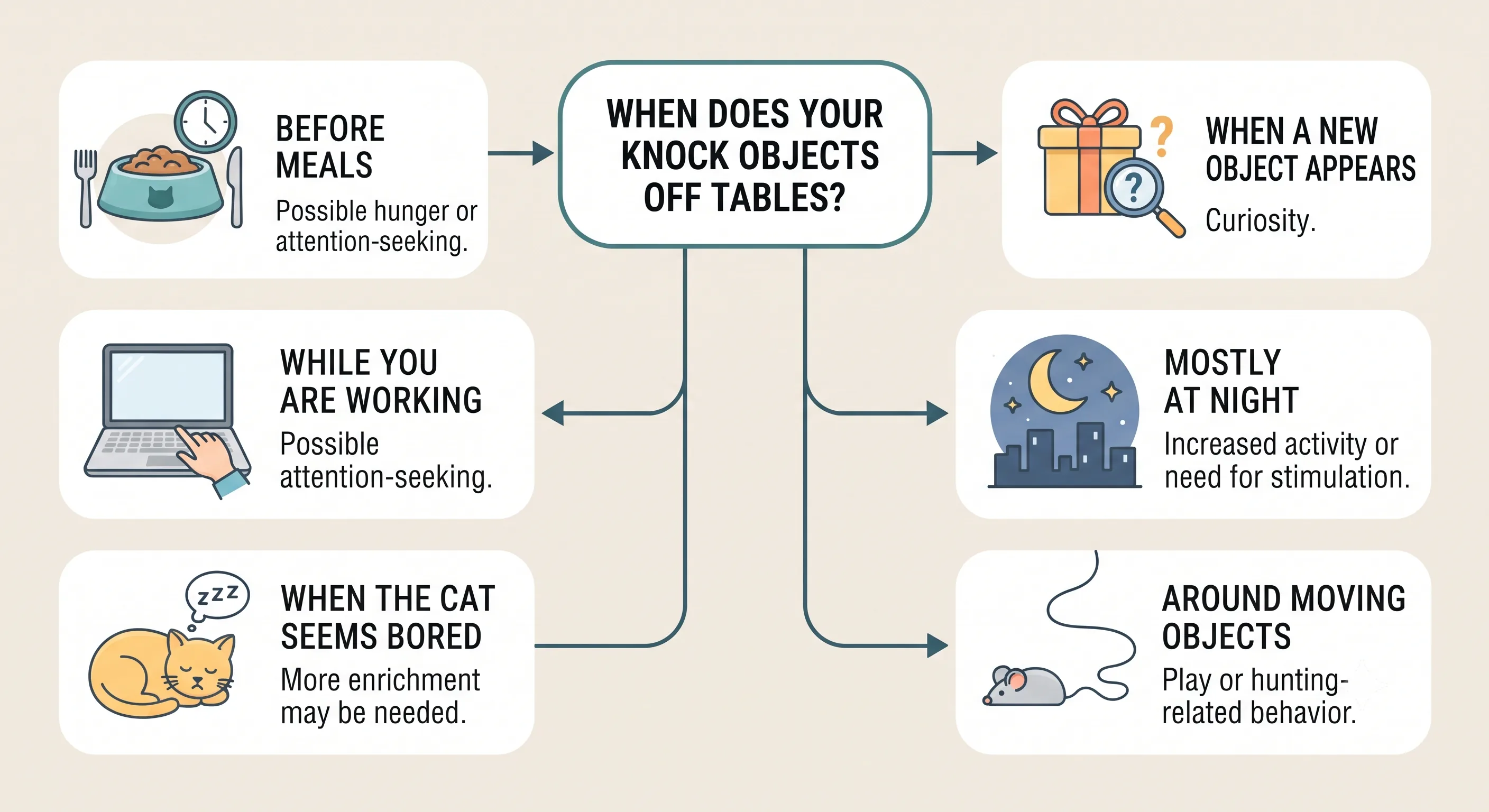
Before trying to stop your cat from knocking things over, pay attention to when it happens.
Does your cat do it:
- Before meals?
- When you're working?
- When you're using your phone?
- When they're bored?
- When a new object appears?
- Mostly at night?
The timing can give you a clue about the reason behind the behavior.
For example, knocking things over before meals may be connected to attention or hunger, while knocking objects over when you're working may be an attempt to get your attention.
Once you understand the trigger, it's much easier to choose the right solution.
Give Them More Playtime
Interactive play is one of the easiest ways to redirect a cat's energy.
Try toys that encourage chasing, pouncing, batting, and stalking.
Some good options include:
- Wand toys
- Small cat balls
- Toy mice
- Crinkle toys
- Puzzle feeders
- Treat-dispensing toys
Even 10–15 minutes of focused play can help, especially if your cat doesn't get much activity during the day.
Try to make playtime interactive rather than simply leaving a toy on the floor.
Keep Valuable Objects Out of Reach
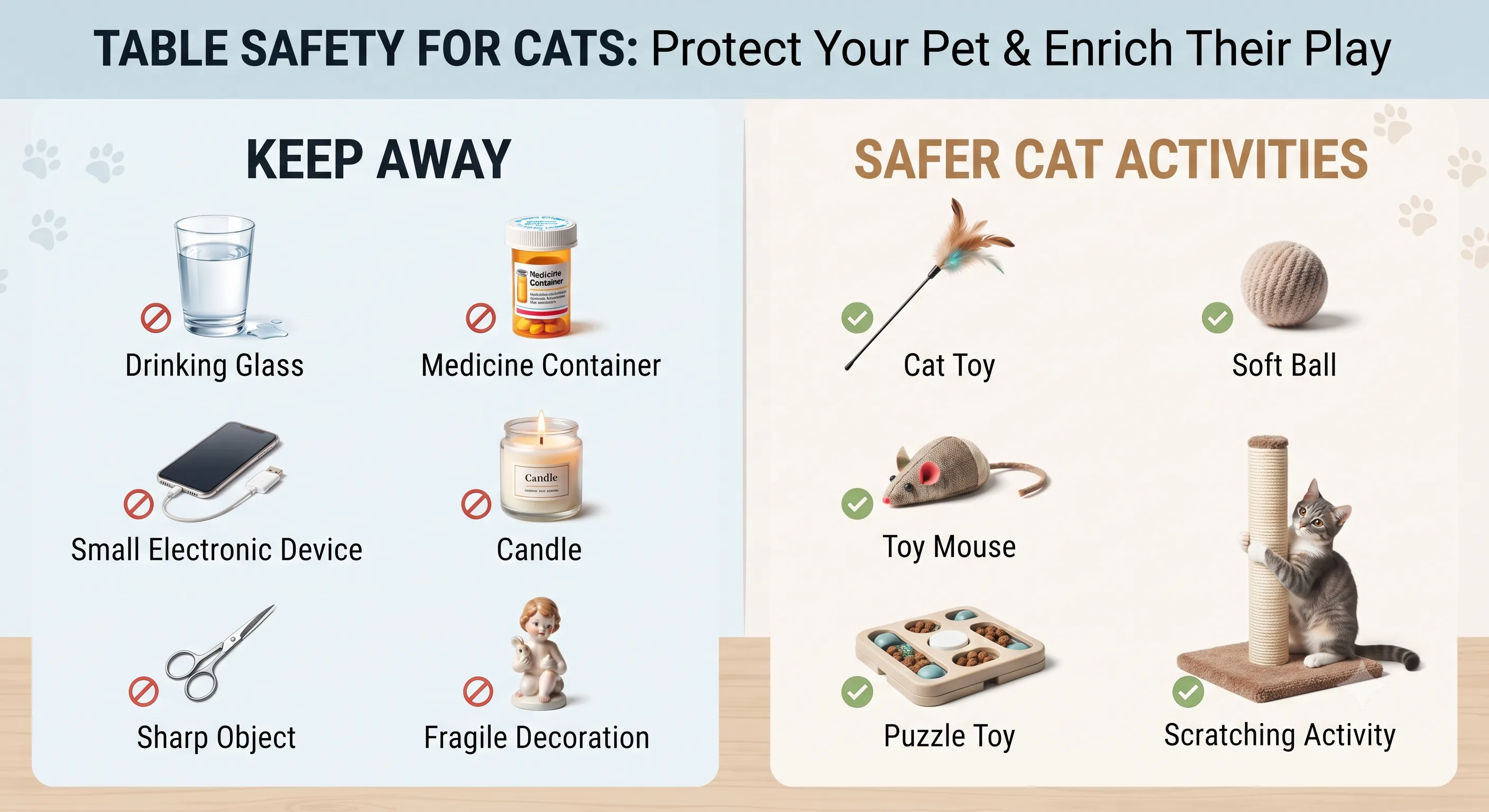
If your cat has a habit of knocking things over, don't leave fragile or dangerous objects near the edge of a table.
Keep things like:
- Glasses
- Medicines
- Small electronics
- Candles
- Sharp objects
- Breakable decorations
Away from areas your cat can easily access.
Some objects can be dangerous if they fall, break, or are chewed by your cat.
This isn't about giving in to your cat. It's about preventing accidents while you're working on the behavior.
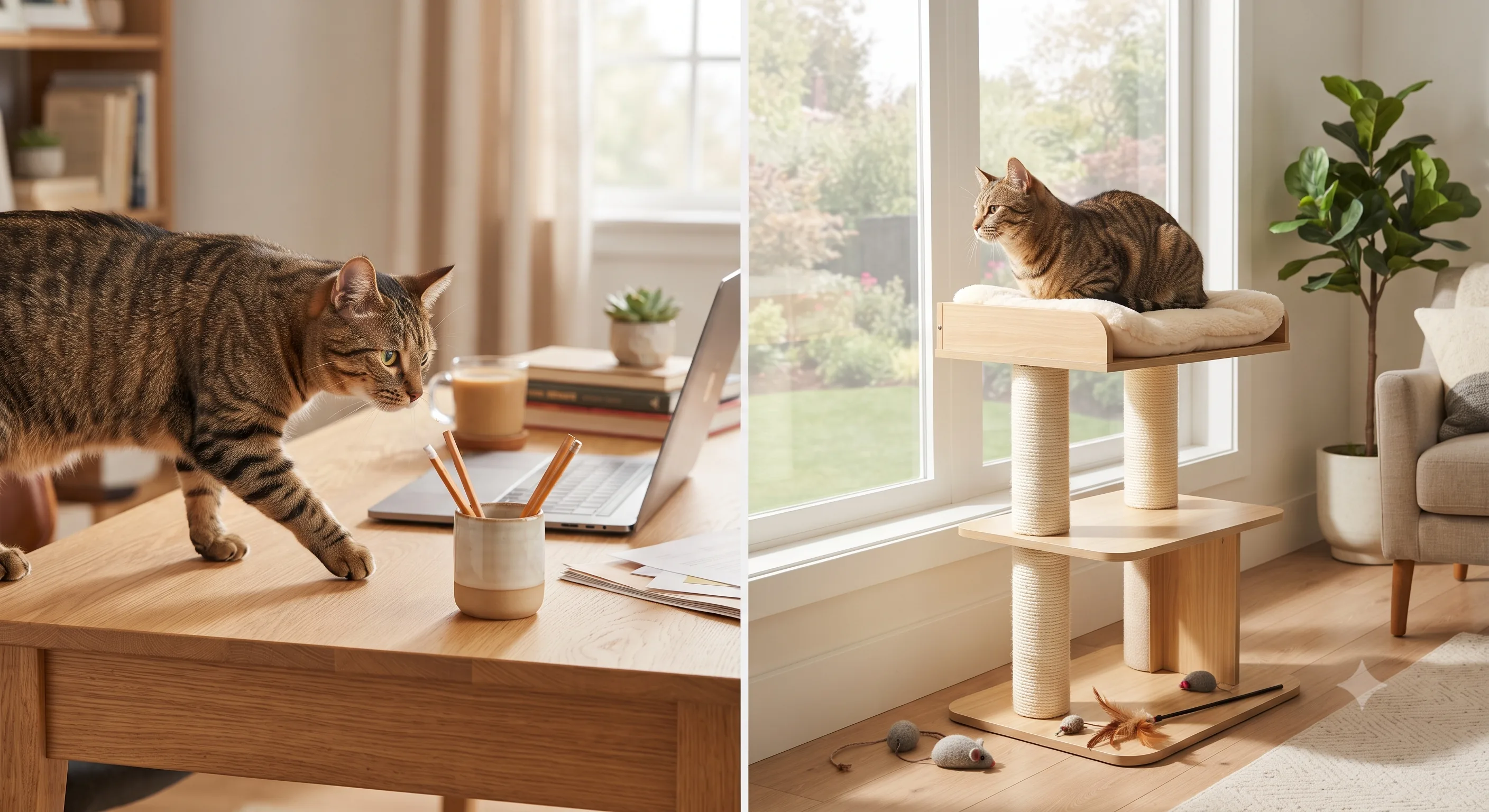
Give Your Cat a Better Place to Climb
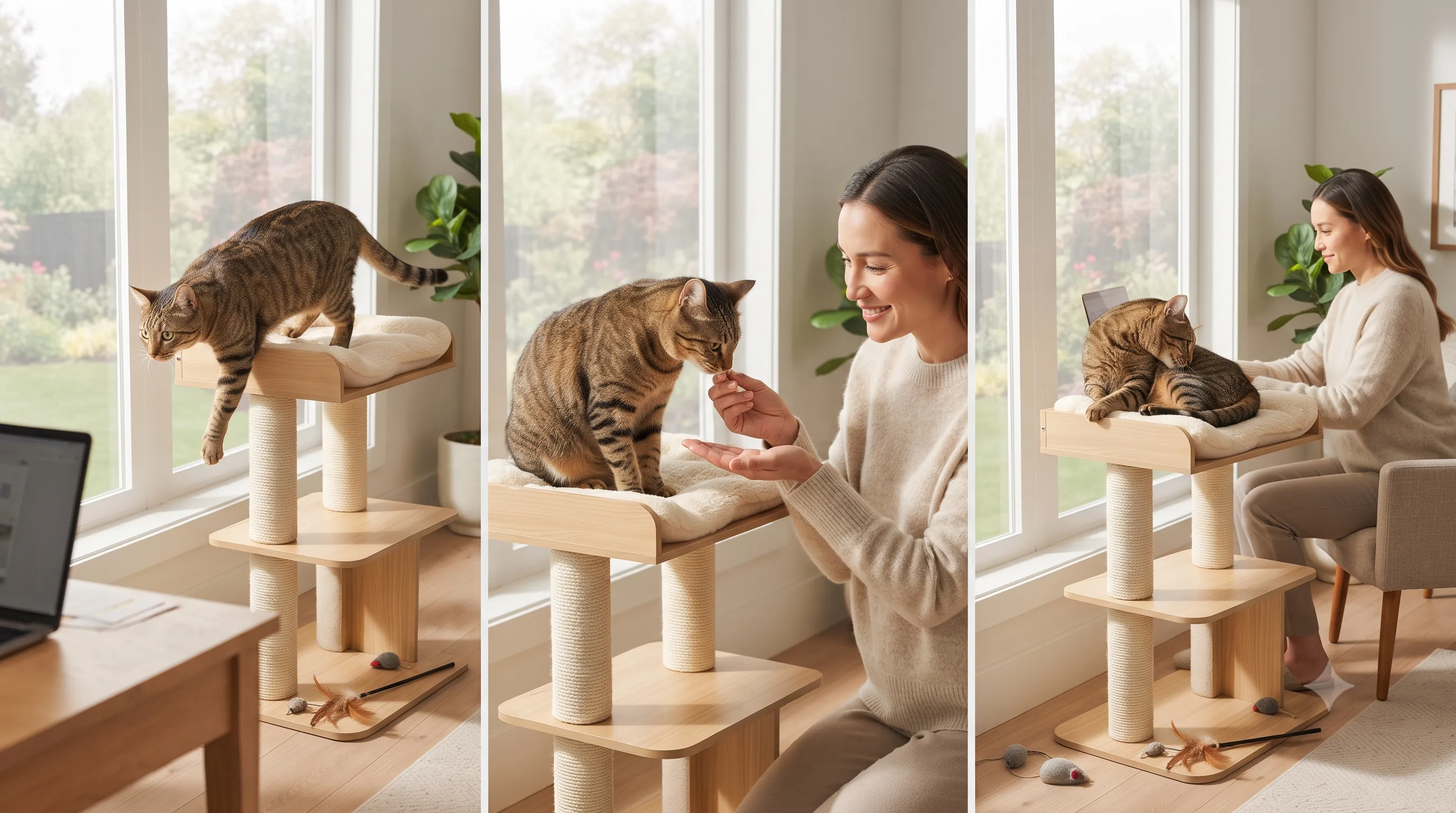
If your cat loves being on tables, give them another elevated option.
A cat tree, shelf, window perch, or sturdy climbing area can provide a safe place to observe the room.
Cats often enjoy elevated spaces because they provide a better view of their surroundings.
Try placing the alternative somewhere your cat actually enjoys spending time.
A window with a view of birds, people, or outdoor activity can be especially entertaining.
Don't Turn It Into a Game
If your cat knocks something down and you immediately chase them around the room, they may see the whole thing as exciting.
Try to stay calm.
Move the object away and redirect your cat toward a toy, scratching post, cat tree, or another appropriate activity.
The less exciting the unwanted behavior becomes, the less rewarding it may be.
Reward Good Behavior
Positive reinforcement can work better than punishment.
When your cat chooses their scratching post, cat tree, bed, or toy instead of your table, give them attention or a small reward.
For example, if your cat jumps onto their cat tree instead of climbing onto your desk, reward them while they're using the appropriate space.
Over time, they can learn which behaviors get positive results.
Should You Punish Your Cat for Knocking Things Over?
It's best to avoid yelling, hitting, spraying water, or deliberately frightening your cat.
Punishment may stop the behavior temporarily, but it can also create fear and make your cat less comfortable around you.
Instead, focus on:
- Preventing access to tempting objects
- Providing more enrichment
- Giving your cat safe climbing areas
- Redirecting unwanted behavior
- Rewarding behaviors you want to see more often
Your cat isn't trying to be a bad pet.
They're simply being a cat.
When Is Cat Knocking Things Over a Problem?
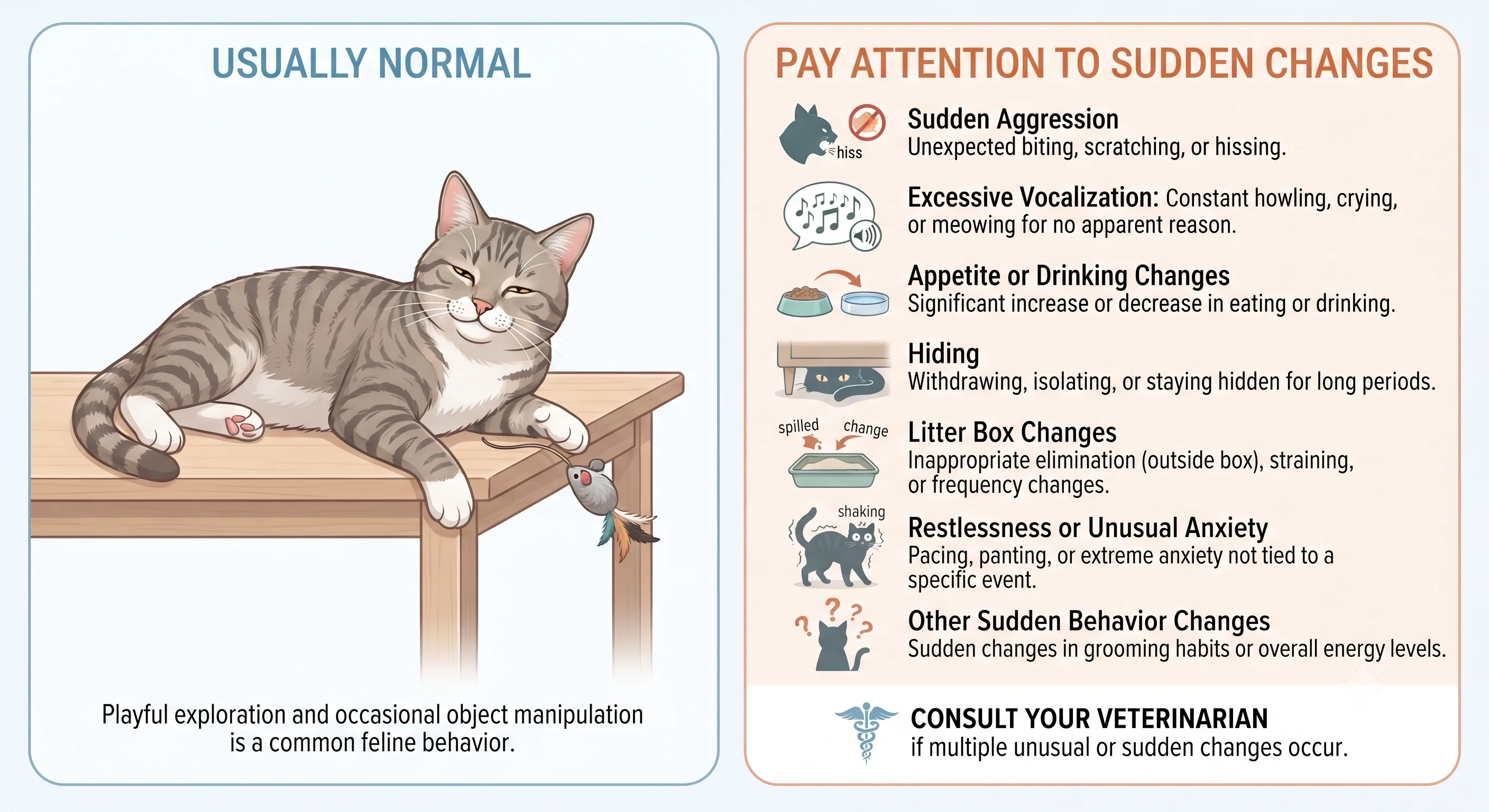
Occasionally knocking things off tables is usually normal cat behavior.
However, a sudden major change in behavior is different.
If your cat suddenly becomes much more destructive or the behavior appears alongside other unusual changes, pay attention.
Watch for things such as:
- A sudden increase in aggression
- Excessive vocalization
- Changes in appetite or drinking
- Hiding more than usual
- Changes in litter box habits
- Restlessness or unusual anxiety
- Other sudden behavior changes
If you notice several unusual changes at the same time, it's a good idea to speak with a veterinarian.
The important thing is to look at the overall change in your cat's behavior, rather than assuming that knocking something off a table is automatically a sign of a problem.
Frequently Asked Questions
Why does my cat knock things off the table and look at me?
Your cat may have learned that knocking objects over gets your attention. They may also be curious about how the object moves or falls. If the behavior consistently gets a reaction from you, your cat may repeat it because the interaction itself is rewarding.
Why does my cat knock things off the table at night?
Cats can become more active during the evening or at night. If your cat is bored, looking for stimulation, or trying to get your attention, they may knock objects off tables during these active periods.
Providing interactive play, enrichment, and appropriate activities can help reduce nighttime boredom.
Why does my cat knock things over when I'm working?
Your cat may have learned that knocking something over makes you stop working and pay attention to them.
If this happens regularly, try giving your cat a short interactive play session before you start working and provide an interesting nearby activity, such as a puzzle feeder, toy, or cat perch.
How do I stop my cat from knocking things over?
Start by identifying why your cat is doing it.
Then remove dangerous or tempting objects, provide more play and enrichment, give your cat appropriate climbing areas, avoid turning the behavior into a game, and reward good behavior.
Is knocking things off tables normal cat behavior?
Yes. Occasional table-knocking is generally normal cat behavior.
Cats may push objects because they're curious, playful, bored, interested in movement, exploring their environment, or trying to get attention.
A sudden change in behavior combined with other unusual symptoms is more worth investigating.
The Bottom Line
So, why does your cat knock things off tables?
It could be curiosity, play, boredom, hunting instincts, attention-seeking, hunger, or simply the fascination of watching something move and fall.
The good news is that you don't have to fight your cat's natural instincts.
Instead, give them safe ways to:
- Play
- Climb
- Explore
- Scratch
- Hunt
- Solve simple problems
- Get your attention
Once you understand what your cat is trying to achieve, it becomes much easier to redirect the behavior.
And maybe move your favorite coffee mug a little farther from the edge. 😹
Does Your Cat Knock Things Off Tables?
Now it's your turn!
Does your cat carefully push things off the table while staring directly at you?
Or do they simply knock everything over and walk away like nothing happened?
Tell us about your cat's funniest table-knocking habit in the comments!
Related articles
Why Does My Cat Follow Me Everywhere? 10 Reasons Your Cat Won't Leave Your Side
Why does your cat follow you everywhere? Discover 10 reasons cats follow their owners, what this behavior means, funny real-life cat stories, and when clinginess may signal a problem.

Why Does My Cat Wake Me Up at Night? Common Reasons and How to Help
Does your cat wake you up at night? Discover why cats become active after bedtime, why they may meow at 3 a.m., and practical ways to help your cat sleep peacefully.

Why Does My Cat Bite Me Then Lick Me?
Wondering why your cat bites you and then licks you? Learn what this behavior means, when it is affectionate or playful, how to read your cat's body language, and when a bite may be a sign of stress or pain.